
 Copy Link


Google Posts are a powerful tool in Google Business Profile that lets businesses engage with customers directly on search results. Discover 5 best practices and tips for maximising their impact on local SEO.
For international hotels, serving guests in multiple languages is part of everyday business. A property may have a local-language name, an English version used for international guests, or branding that appears in more than one script.
This raises an important question for hospitality teams:
Should our Google Business Profile use the local-language name, an English version, or both?
The question has become particularly relevant following a recent update to Google’s Business Profile guidelines. Google now explicitly states that repeating the same business name in multiple scripts or languages is not permitted in the Business Name field, even when the bilingual version appears on the property’s physical storefront signage.
At the same time, Google Maps may provide separate, language-specific fields for business names. This distinction is important for hotels operating across multilingual markets.
Your Business Name Should Reflect Your Real-World Identity
Google’s guidelines state that a Business Profile name should reflect the business’s real-world name as it is consistently represented and recognised across signage, websites, stationery, and other branding.
The Business Name field is not an SEO opportunity. Adding locations, amenities, services, or promotional phrases to capture additional searches is not permitted and could result in Business Profile suspension.
For a hypothetical property whose established name is Hotel Sakura:
✖ Incorrect: Hotel Sakura Tokyo – Luxury Accommodation Near Shinjuku
✔ Correct: Hotel Sakura
The name should identify the property, not describe or promote it.
What About Bilingual or Multi-Script Names?
This is where Google’s latest guideline update is particularly important for international hospitality businesses. Google now specifically lists “Repeated Bilingual Names / Script Transliterations” as not acceptable. The examples provided include:
✖ Kafiex / カフィエクス
✖ Burger King バーガーキング
while the single-script versions are acceptable:
✔ Kafiex
✔ Burger King
Importantly, Google states that this restriction applies even when the repeated name appears on physical storefront signage. This means that a hotel should not assume that displaying its name in two scripts on its building signage makes a dual-script Business Profile name acceptable.
For example, should not be entered as the Business Name simply because both versions appear on the hotel’s signage. The Business Name field should instead contain the property’s established name without adding a repeated translation or transliteration.
✖ ホテルさくら / Hotel Sakura
How Google Business Profile and Google Maps Handle Different Languages
For hotel teams, one point is especially important: the Business Profile dashboard manages one primary Business Name field. This should reflect the property’s established real-world identity, which may be its local-language name. Multiple language versions should not be combined within the same field.
The distinction is simple:
● In the Business Profile dashboard: Maintain one accurate primary business name.
● In Google Maps: Where separate language-specific name fields are available, use them for genuine versions of the property’s name.
However, Google Maps may still display recognised versions of a business name in different languages, as illustrated in the example below.
Name in English: Hilton Kyoto
Name in Japanese: ヒルトン京都
✔ This is different from entering Hilton Kyoto / ヒルトン京都 in a single Business Name field.
In practice, the additional language option can be accessed through Google Maps by changing the Maps interface to the relevant language and using Suggest an edit → Change name or other details. The exact interface and available fields can vary by language, region, device, and account. Google also notes that some Business Profile editing features differ across Search and Maps, as well as by device and operating system.
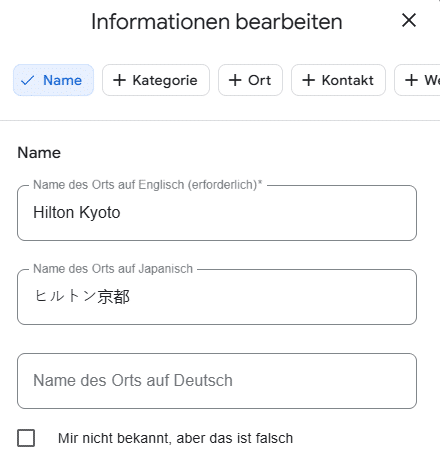
Example of the language-specific business name fields available through Google Maps.
Should Hotels Use an English Business Name?
Not as an SEO tactic alone. If a hotel’s established business name is in the local script, replacing it with an English translation purely to target international searches is not a sound local SEO strategy.
An English name can be appropriate when it reflects the property’s established business identity, as may be the case with an international hotel brand that consistently uses an English name across its markets.
The deciding factor should be how the property is genuinely known and represented, rather than which language is expected to generate more searches.
Check How the New Name Appears Across Google’s Markets
When a hotel changes its Business Name, the update should not be treated solely as a Google Business Profile dashboard task.
Hotels should also review how the property name appears across Google’s country-specific domains, such as google.co.uk and google.de, particularly when the property operates under different recognised language versions of its name. If inconsistencies are identified, additional correction requests may be necessary, depending on how Google displays the property’s information in different markets.
As part of the name-change process, Luau recommends checking the property’s representation across relevant markets rather than assuming that a dashboard update will immediately be reflected consistently everywhere.
What Hotels Can Control and What Google Determines
For properties operating across multiple languages, it is useful to separate the information the business provides from how Google presents it.
Hotels can manage:
✔ Their primary Business Profile name;
✔ Recognised language-specific name information where available through Google Maps;
✔ Consistent naming across their official website, local-market websites, OTAs, social media, and other customer-facing channels.
Google determines:
✔ How business information is ultimately displayed across Search and Maps;
✔ Which language version is presented in a particular context;
✔ How information from different sources is interpreted and displayed.
Rather than trying to control every variation that appears on Google, hotels should focus on providing accurate and consistent information.
Key Takeaway
Google’s updated guidelines make the distinction clear: the Business Name field should not repeat the same business name across multiple languages or scripts, even when that format appears on physical signage.
For international hotels, the focus should remain on an accurate primary business name. Where Google Maps provides separate language-specific fields, genuine local-language versions can be managed separately rather than combined into the primary name.
The goal is not to fit every language variation into one field, but to give Google accurate and consistent information in the appropriate place.

Blog posts you may also like


Discover how Google Questions & Answers can revolutionize your customer engagement strategy. Enhance credibility, increase visibility, gain insights, and build trust through this interactive platform.

Boost your local business’s visibility and conversions with on-page SEO. Focus on optimising meta titles and descriptions, ensuring NAP consistency, and enhancing mobile-friendly experience and page load speed.
Maximise your hotel’s visibility with Google Business Profile amenities optimisation. Update features like free Wi-Fi, pools, or pet-friendly policies to boost relevance in local searches and attract more guests.